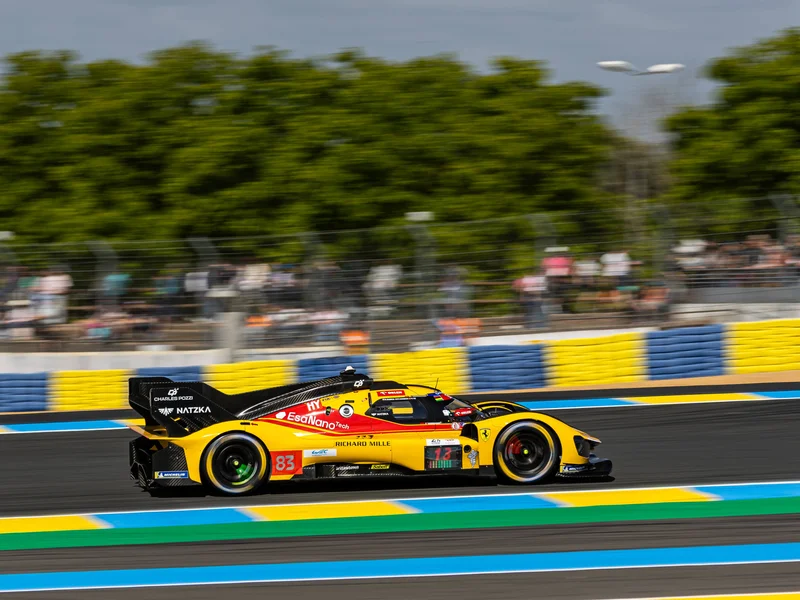
FerrariTeam·Ferrari is preparing a significant overhaul of its 499P Le Mans Hypercar for the 2027 World Endurance Championship season, marking the first major technical reset of the project since its debut.
According to the plans outlined in Italian media, the marque intends to use all, or almost all, of its remaining four development jokers in preparation for the new campaign. In WEC’s Hypercar ruleset, these jokers allow manufacturers to make a limited number of homologated updates across the life of a prototype, making their deployment a strategic decision with long‑term consequences for performance and competitiveness.
The move comes after an extraordinary first cycle for the 499P. FerrariTeam·Ferrari returned to the top class of endurance racing in early 2023 with the car and proceeded to win three consecutive editions of the 24 Hours of Le MansCompetition·24 Hours of Le Mans. Over the same period, the programme also captured both the manufacturers’ and drivers’ titles in the 2025 WEC season. Despite that dominance, the 499P has remained remarkably stable in technical terms.

Since its introduction, FerrariTeam·Ferrari has made only one very small technical change to the prototype, implemented after its second Le Mans victory in 2024. At the start of the current season, as all Hypercar contenders went through a re‑homologation phase, Maranello introduced only minimal aerodynamic tweaks, choosing incremental refinement over aggressive development.
That philosophy is now set to shift. FerrariTeam·Ferrari technical director Ferdinando CannizzoCoach·Ferdinando Cannizzo explains that the team is ready to address several areas of the car in a coordinated way, rather than chasing isolated gains. He indicates that the planned 2027 package will likely involve around three development jokers, potentially rising to four depending on how the regulations interpret the scope of the changes. The emphasis is on treating the 499P as an integrated system, as it was during its original conception, rather than layering on piecemeal updates.
The timing is telling in the context of the Hypercar balance of power. The class has grown into a dense manufacturer battleground, with AlpineTeam·Alpine, Aston MartinTeam·Aston Martin, BMWTeam·BMW, CadillacTeam·Cadillac, Genesis (Hyundai)Team·Genesis (Hyundai), PeugeotTeam·Peugeot, ToyotaTeam·Toyota and FerrariTeam·Ferrari all featuring in fan polls and competitive discussions. With Balance of Performance (BoP) tightly controlling lap times, any major technical step carries risk: a faster car can quickly attract BoP adjustments, while misjudged upgrades can be locked in by the homologation rules for several seasons.
By concentrating its remaining jokers into a single, integrated 2027 evolution, FerrariTeam·Ferrari is effectively betting on a refreshed performance and efficiency window that can sustain the programme into the next regulatory phase. The update is likely to target areas typically critical in modern endurance racing: aerodynamic efficiency across multiple downforce levels, weight distribution and tyre usage, energy deployment and recovery strategies in the hybrid system, and drivability over long stints in changeable conditions. The manufacturer has not yet detailed which components will change, and under the regulations it is not obliged to disclose full specifications before homologation.

Strategically, the 2027 package signals that FerrariTeam·Ferrari views the 499P not as a short‑term project, but as a platform designed to evolve through a full rules cycle. After proving the baseline concept with minimal modifications during a title‑winning phase, the team now appears ready to commit its final regulatory flexibility to ensure the car remains a reference point in the category.
For rivals, the announcement is a reminder that the current hierarchy is not fixed. Manufacturers managing their own jokers will watch closely how FerrariTeam·Ferrari balances outright pace with BoP exposure, and whether the 2027 evolution redefines the performance ceiling in race trim rather than in qualifying headlines. For the championship, a renewed 499P promises another chapter in a competition that has already helped re‑establish Le Mans and WEC Hypercar as a global showcase for factory prototype racing.
The specifics of the 2027 FerrariTeam·Ferrari will emerge only as the homologation deadline approaches, but the direction is clear: after a dominant and relatively conservative first act, the 499P story is entering a more aggressive development phase, with the stakes raised for both Maranello and its Hypercar rivals.

Ferrari AF Corse's 499P #51 Hypercar during the 2026 Le Mans Pit Stop Challenge. (PsnewZ/IMAGO)
PsnewZ/IMAGOThis article was generated by AI (sonar-pro). Learn more.